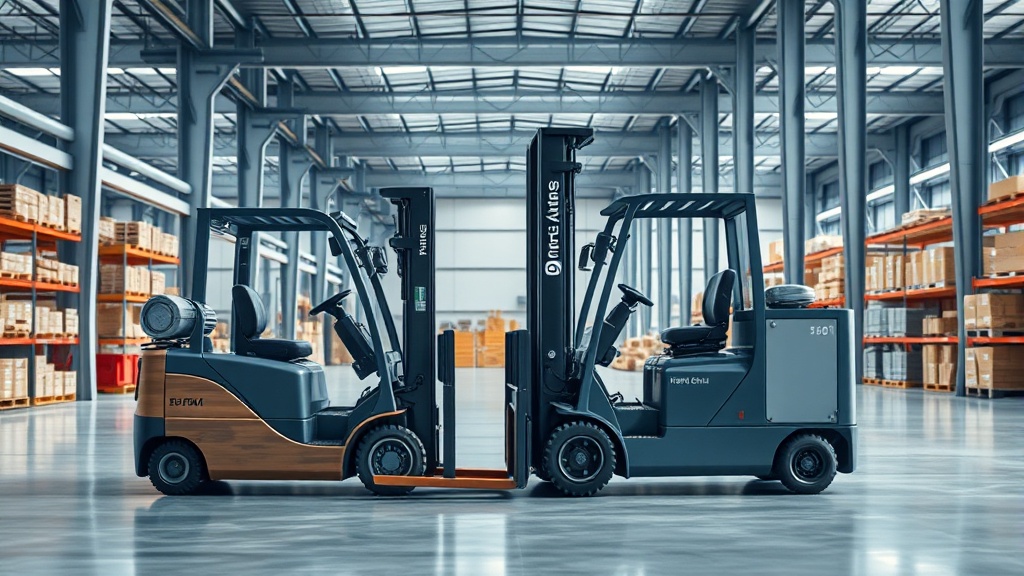
Battery vs Hydrogen Forklifts: 2026 Comparison Guide

Hook
Ever stared at a warehouse aisle and wondered whether the buzzing of a battery‑powered forklift or the hiss of a hydrogen unit is the smarter choice? The hype around "green" forklifts is loud, but the reality on the concrete is far quieter — and a lot more expensive than the marketing decks suggest.
Context
As a logistics veteran, I’ve seen warehouses chase the latest tech only to end up with hidden costs that crush ROI. In this guide I cut through the hype and compare battery and hydrogen forklifts on the metrics that actually matter to a mid‑size distribution center.
What’s the real upfront price tag?
Battery forklifts typically start around $30k–$45k per unit, while hydrogen models sit in the $70k–$100k range. The gap isn’t just the vehicle; it’s the infrastructure. A battery depot with fast chargers can add $15k–$25k per charging bay, whereas a hydrogen refuel station can cost $150k–$250k for a modest 5‑unit fleet.
"The infrastructure spend often eclipses the vehicle cost," notes the U.S. Department of Energy’s Office of Energy Efficiency & Renewable Energy (EERE) (2025).
How does downtime compare in a real‑world setting?
Battery chargers, even fast‑charge units, still need 30–45 minutes to top up a 2‑hour run‑time battery. In a busy 24‑hour operation that translates to 2–3 lost cycles per day. Hydrogen cells refuel in under 5 minutes, essentially matching diesel turnover. For a 10‑forklift fleet, that difference can mean up to 30 extra operating hours per week.
Which powertrain handles temperature extremes better?
Cold storage facilities are brutal on lithium‑ion cells — capacity can drop 20‑30% at 0 °C. Hydrogen fuel cells maintain performance across a broader temperature range, making them a better fit for refrigerated zones. Sources like Hydrogen Europe’s 2024 performance report confirm a 5‑10% efficiency dip only in extreme cold, versus the steep decline for batteries.
What about total emissions?
If you source hydrogen from green electrolysis, the lifecycle CO₂ can be <30 g CO₂/kWh, comparable to battery electricity from renewable grids. However, most commercial hydrogen today is still grey (derived from natural gas), emitting ~10 kg CO₂ per kg H₂ — essentially the same as diesel when you factor in production. See IEA’s Hydrogen Review 2025 for the breakdown.
Which option offers the best ROI for a 5‑year horizon?
Using a simple TCO model (purchase, infrastructure, energy, maintenance), battery forklifts break even at 3.5 years in high‑utilization (≥80%) scenarios, while hydrogen reaches break‑even at 4.8 years only if you have fast‑turnover, cold‑chain operations and access to cheap green hydrogen (≈$3/kg). For most midsize warehouses, batteries still win on pure dollars, but hydrogen can dominate when downtime costs outweigh capital spend.
How do safety and regulations differ?
Hydrogen brings flammability concerns — you need explosion‑proof zones, ventilation, and regular leak testing. Batteries pose thermal‑runaway risks, especially if chargers are overloaded. Both require OSHA‑compliant training, but hydrogen adds a layer of permitting that many facilities overlook.
What do other warehouse pros say?
In a recent Supply Chain Dive poll (2025), 62% of respondents favored batteries for cost, while 28% chose hydrogen for “speed of refuel and cold‑chain suitability.” The remaining 10% stuck with diesel out of inertia.
Takeaway — Which forklift fits your warehouse?
- If your operation runs 24/7, needs rapid turn‑around, and houses cold‑storage aisles, hydrogen may justify the higher capex.
- If you have a moderate‑utilization fleet, can schedule charging during off‑peak hours, and want the lowest upfront spend, battery electric is the pragmatic choice.
- Never ignore the hidden infrastructure costs — a cheap‑priced forklift can become a budget hole once you factor in chargers or refuel stations.
Bottom line: Don’t chase the “green” label alone. Look at the full cost of ownership, downtime impact, and your specific temperature and safety constraints. The right powertrain will keep your warehouse humming, not just humming with hype.
Related Reading
- Edge AI in Warehouse Robotics 2026 – What the Real Performance Numbers Look Like — A deep dive into the AI that guides autonomous forklifts.
- Predictive Maintenance AI in 2026: What the Vendor Deck Leaves Out — How AI can spot forklift battery degradation before it happens.
- Warehouse Connectivity Strategy 2026: Wi‑Fi 7 vs Private 5G — Choosing the right network for real‑time forklift telemetry.