100 Robots, 50,000 SKUs: What NAPA's Automation Bet Actually Means

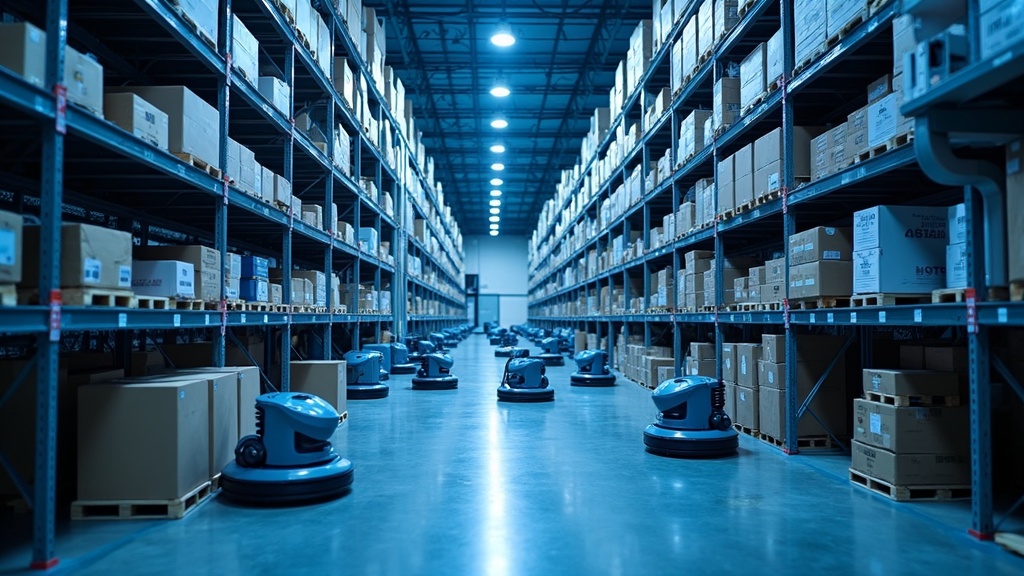
While Silicon Valley obsesses over humanoid robots that can fold laundry, 100 warehouse bots just started moving brake pads and alternators in the unglamorous world of automotive aftermarket distribution.
NAPA—yes, the parts store you see on every other corner in America—just signed a deal with Brightpick for 100+ AI-powered warehouse robots. The pilot worked. They're scaling. And this matters more than 90% of the "AI breakthroughs" you'll read about this week.
Here's why I'm pulling the thread on this one.
The Theater vs. The Plumbing
We've been inundated with demos of robots that can (sort of) walk, (occasionally) grasp objects, and (theoretically) replace human workers in unstructured environments. The hype cycle has us believing that general-purpose humanoids are months away from revolutionizing labor.
The reality?
The real deployment—the kind that actually moves the needle on operational efficiency—is happening in controlled, structured environments where the problem isn't "walking across a room" but "finding one specific brake pad among 50,000 SKUs in under two minutes."
Follow the incentive structure here: NAPA operates 6,000 stores across North America. Their distribution centers aren't trying to win robotics competitions—they're trying to get the right part to the right store before the customer walks out. That's a $50 billion aftermarket with zero tolerance for stockouts on critical components.
The SKU Problem Nobody Talks About
Let me put this in perspective that actually matters.
A single vehicle model might require 30,000 different parts over its lifecycle. Multiply that across decades of production, multiple manufacturers, and regional variants, and you're managing a parts catalog that would make Amazon's book inventory look like a corner store.
This is the "long tail" problem that breaks traditional automation:
- High-volume, predictable items (oil filters, wiper blades) move fast and consistently
- Low-volume, intermittent items (that one specific alternator for a 2007 Subaru Outback) sit in the warehouse for months, then suddenly get urgent demand
- Seasonal patterns (winter brake pads, summer coolant) create demand spikes that don't follow e-commerce rhythms
Traditional warehouse automation—the kind that dominated the 2010s—struggles with this. Fixed automation works when you're moving identical boxes of identical products to identical destinations. It falls apart when every third tote contains a completely different part with a completely different velocity profile.
Why Goods-to-Person (Finally) Makes Sense Here
Brightpick's approach isn't revolutionary in the way the press releases claim. It's evolutionary in a way that actually works.
Goods-to-person systems—where robots bring shelves to human pickers instead of humans walking to shelves—have been around for years. The economics only pencil in specific scenarios:
The math has to work on three variables:
- Pick density: How many orders per hour can a human fulfill when the robot brings the inventory?
- SKU breadth: How diverse is the inventory, and how often does the "right" shelf need to move?
- Throughput variance: Can the system handle Tuesday's quiet shift and Saturday's panic equally well?
NAPA's environment hits the sweet spot: high pick density (thousands of stores placing orders daily), massive SKU breadth (that 50,000+ catalog), and significant throughput variance (emergency orders vs. routine restocking).
The pilot worked. They're scaling. That tells you the unit economics passed the warehouse floor test—where a million-dollar "innovation" dies because the Wi-Fi doesn't reach the loading dock or the UI requires a PhD to operate.
The Signal in the Noise
Here's what NAPA's deployment actually signals about the state of warehouse automation in 2026:
1. Pilot-to-production cycles are shortening.
The NAPA-Brightpick pilot ran through 2025. By early 2026, they've signed for an additional site. That's not the 3-5 year implementation cycles we saw in the last decade. The technology is becoming modular enough that deployment isn't a capital project—it's an operational decision.
2. Automotive aftermarket is becoming automation's proving ground.
This sector has the complexity of pharma (regulatory tracking, safety-critical parts) with the velocity of retail (consumer expectations, price pressure). If automation works here, it works almost anywhere.
3. The "AI" component is less about intelligence and more about optimization.
Brightpick's software isn't "learning" to pick parts. It's optimizing retrieval paths, predicting demand clusters, and dynamically reshuffling inventory based on velocity data. It's operations research dressed up in AI marketing—and that's actually more useful than the alternative.
The Impact Scorecard
| Dimension | Score | Rationale |
|---|---|---|
| Accessibility | 6/10 | Still requires significant capital and integration expertise. Mid-market players are priced out. |
| Utility | 8/10 | Solves a real, expensive problem. ROI is measurable in pick accuracy and labor efficiency. |
| Longevity | 7/10 | The approach scales, but vendor lock-in and hardware obsolescence are real risks over 10-year horizons. |
So What?
If you're a logistics professional: This is your sign that goods-to-person robotics has crossed from experimental to operational. The question isn't whether to automate—it's whether your SKU complexity justifies the capital outlay.
If you're in automotive: The aftermarket is about to bifurcate. Players with automation will handle complexity at scale. Players without it will be limited to the high-velocity, low-complexity segments—where margins are already compressed.
If you're watching the robotics sector: Stop paying attention to walking demos. Start paying attention to deployment velocity in messy, legacy industries. NAPA's 100-robot deal isn't sexy. It's infrastructure. And infrastructure is where the money actually flows.
The robots aren't coming to replace us in some dystopian future. They're already here, quietly sorting brake pads in warehouses that haven't seen a press release since 1987. The signal isn't in the theater—it's in the plumbing.
Want to pull the thread on something specific? Reply or drop a note—I'll follow the incentive structure and tell you what actually matters.